Fulfilled by TikTok (FBT) vs. Self-Fulfilled: Which Is Cheaper?
FBT hands storage, pick-pack, and shipping to TikTok; self-fulfilled keeps it in-house. Here's how the two models compare on cost, control, and the numbers that actually hit your margin.
On TikTok Shop US you can either let TikTok store, pack, and ship your orders (Fulfilled by TikTok, or FBT) or handle fulfillment yourself (self-fulfilled). Neither is universally cheaper: FBT trades a per-unit fulfillment fee for speed and hands-off logistics, while self-fulfilled keeps fulfillment costs in your control but adds operational work. The right choice depends on your order volume, product size, and how much of the work you want to own — not on a single headline rate.
The two fulfillment models
Fulfilled by TikTok (FBT)
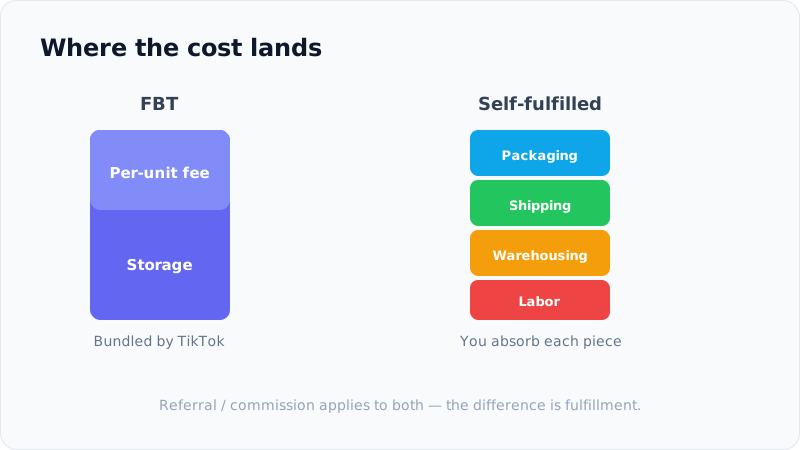
You ship inventory into TikTok's fulfillment network up front. From there TikTok picks, packs, ships, and handles a large share of customer-service and returns logistics for each order. You pay storage for the inventory you hold plus a fulfillment fee per unit shipped. In exchange you get faster, more consistent delivery promises — which can lift conversion on a platform where shoppers expect quick shipping.
Self-fulfilled
You keep inventory in your own (or a third-party) warehouse and ship each order yourself when it comes in. There's no TikTok fulfillment fee and no TikTok storage fee, but you absorb your real-world costs: packaging, the shipping label, your own warehousing, and the labor to pick and pack. You also own returns handling end to end.
Cost comparison at a glance
| Cost dimension | Fulfilled by TikTok (FBT) | Self-fulfilled |
|---|---|---|
| TikTok referral / commission | Yes — applies to both | Yes — applies to both |
| Per-unit fulfillment fee | Charged by TikTok | None (you pay real shipping) |
| Storage | Charged by TikTok for stored inventory | Your own / 3PL warehousing |
| Packaging & labor | Included in the fulfillment fee | You absorb it |
| Shipping speed | Fast, platform-backed promise | Depends on your operation |
| Returns handling | Largely handled by TikTok | You handle it |
| Up-front commitment | Send inventory in first | None |
When FBT usually wins
- You sell small, light, fast-moving products where the per-unit fee stays low.
- Order volume is high enough that doing it yourself eats real labor hours.
- You want the faster delivery badge to lift conversion.
- You'd rather not run a warehouse or manage returns logistics.
When self-fulfilled usually wins
- Your products are large, heavy, or slow-moving (storage fees punish slow inventory).
- You already have a warehouse or favorable 3PL / carrier rates.
- Volume is low or spiky and you don't want inventory committed up front.
- Your margins are thin and you can ship cheaper than the FBT fee.
The fees that actually decide it
Because the referral/commission fee applies to both models, it doesn't break the tie — the deciding number is fulfillment. Compare TikTok's all-in FBT cost (storage + per-unit fulfillment) against your true self-fulfilled cost (packaging + label + warehousing + labor) for the same product. Whichever is lower, after factoring the conversion lift FBT's speed can bring, is the cheaper option for that SKU. It often differs SKU by SKU, so check your best sellers individually rather than picking one model for the whole catalog.
Run your own numbers
The only way to know is to plug your real costs into both models and compare net margin. Profitlee's TikTok Shop calculator does exactly that — switch between Fulfilled by TikTok and self-fulfilled and watch referral fees, fulfillment, PPC, and returns fold into one net-after-everything figure.